Apartment Renovations in Strata: What Needs Approval in 2026
The quick rule
- Cosmetic work is usually fine.
- Minor renovations need approval.
- Major renovations need a proper owners corporation decision, and often a by-law.
Most renovation fights in strata start before the first tile is lifted. An owner thinks they are improving their own apartment. The committee thinks common property, waterproofing, noise, insurance and future damage have just walked through the front door.
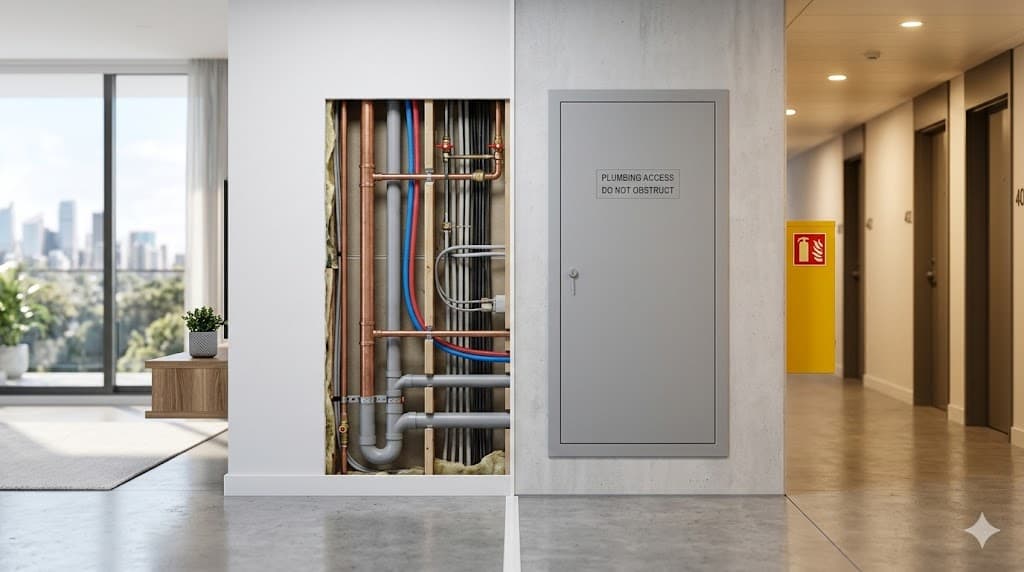
Both can be right. Apartment renovations are different from house renovations because private work often touches shared parts of the building. A new bathroom is inside your lot, but the waterproofing membrane may be common property. New timber flooring is inside your apartment, but the impact noise lands in the apartment below. A split-system air conditioner feels like a private appliance, but the condenser, pipework and penetrations may involve external walls, balconies and common property.
The useful question is not "Is this my apartment?" The useful question is "What part of the building will the work affect?"
Cosmetic Work
Cosmetic work is the low-risk category. In NSW, cosmetic work generally includes things like painting internal walls, installing hooks or nails, replacing blinds or curtains, filling minor holes and laying carpet. It does not affect structure, waterproofing, external appearance or common property.
Most buildings do not require formal approval for this work, though owners should still check the by-laws. Some schemes expand the list of cosmetic works. Others have old by-laws that create unnecessary confusion.
The practical test is whether the work can be reversed without affecting another lot or the building. If yes, it is probably cosmetic. If it involves water, structure, flooring, external walls, services or penetrations, keep reading.
Minor Renovations
Minor renovations are the middle category. They are not trivial, but they are not major structural works either.
In NSW, minor renovations include kitchen renovations, changes to internal walls, changes to recessed light fittings, installing or replacing wood or other hard floors, and installing or replacing wiring, cabling or power points. Approval is required, usually by ordinary resolution, unless the scheme has a by-law that allows the strata committee to approve minor renovation applications.
The 2025 reforms created an important timing rule. If a strata committee has authority under a by-law to decide a minor renovation request, and it refuses the request, it must give written reasons within three months of receiving the request. If it does not refuse within that period, the application is taken to be approved by the committee.
That does not mean owners can send a vague email and start work three months later. The request still needs to be a proper request. Include scope, plans, trades, dates, insurance certificates, acoustic details if flooring is involved, waterproofing details if wet areas are involved, and any proposed access to common property.
Committees should treat the three-month rule as a deadline, not a strategy. Silence is no longer a safe way to avoid a decision.
Major Renovations
Major renovations are the works that change common property, affect the structure, change external appearance, require waterproofing, or involve more serious building risk. Bathroom renovations are the classic example because waterproofing is usually involved. Removing structural walls, altering windows, enclosing balconies, changing external walls and major plumbing works also sit in this category.
Major renovations usually need a special resolution at a general meeting. If the work changes common property for the benefit of one lot, a common property rights by-law may be required. That by-law should state who is responsible for ongoing maintenance, repair, insurance and future damage.
This is where owners often get frustrated. A bathroom renovation feels like normal home improvement. In strata, it can create a long-term liability if the waterproofing fails and damages the apartment below. The committee is not being difficult by asking for waterproofing certificates, licensed trades and clear maintenance responsibility. That is the point of the process.
The Work Over $5,000 Issue
NSW Government guidance also points owners toward building compliance requirements for strata building work, particularly for renovations over $5,000. Depending on the work, registered design practitioners and registered building practitioners may be needed.
Do not treat this as a paperwork detail. If the work later causes water ingress, fire separation problems, acoustic problems or structural damage, the owners corporation will ask who approved it, who designed it, who built it, and what certificates were supplied.
An owner who cannot produce the documents will have a weaker position.
Air Conditioning, Flooring and Bathrooms
Three renovation types cause a disproportionate number of disputes.
Air conditioning often needs approval because the condenser is visible, noisy or fixed to common property. The application should show the condenser location, pipe route, condensate drainage, noise rating, penetrations and who maintains the installation.
Hard flooring needs acoustic care. A timber floor that meets the owner's taste but ruins the neighbour's sleep will become a by-law dispute. The application should include acoustic underlay details and any required acoustic certificate.
Bathrooms need waterproofing discipline. A bathroom renovation that skips the approval process can create years of water damage arguments. The application should include the waterproofing scope, licensed contractor details, certificates and any changes to plumbing or drainage.
A Better Approval Pack
A good renovation request is boring in the right way. It gives the committee enough information to say yes without guessing.
Include:
- The exact scope of works.
- Plans, drawings or marked-up photos.
- Start and finish dates.
- Working hours.
- Contractor licence details.
- Insurance certificates.
- Waste removal and lift protection plan.
- Any common property access required.
- Acoustic details for flooring.
- Waterproofing details for wet areas.
- Proposed by-law, if common property rights are being changed.
Owners who supply this from the start usually get faster decisions. Committees that ask for it consistently avoid looking arbitrary.
What Committees Should Not Do
Committees should not invent new approval categories because they dislike a proposal. The legal categories matter. Cosmetic, minor and major work should be assessed according to the legislation and the scheme's by-laws.
Committees should not demand unnecessary legal work for every small change. A request to replace kitchen cupboards is different from a request to cut through a common wall.
Committees should not ignore applications. The three-month minor renovation rule has made inaction riskier, and ignoring owners usually creates worse disputes than making a clear decision.
Committees should also keep records. NSW owners corporations must keep records of approved minor renovations for 10 years. That record helps future owners, buyers, committees and insurers understand what has been changed.
What UnitBuddy Tracks
UnitBuddy can record renovation applications by lot, approval status, conditions, by-laws, certificates, insurance documents and completion dates. It gives committees a single history of what was approved and what conditions applied.
That matters years later, when a buyer asks whether the bathroom was approved or a downstairs owner reports water staining in the ceiling.