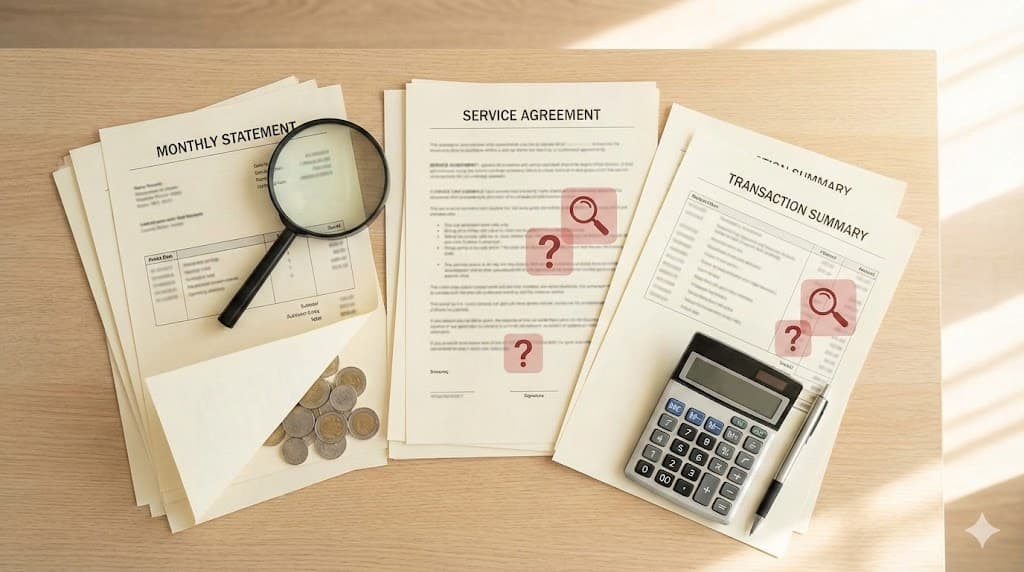
The Hidden Fees in Your Strata Contract
Understanding Schedule B, C, D, E & F fees — and why they matter more than the headline price
When your owners corporation signs a strata management agreement, the headline management fee is usually the number everyone focuses on. But the real cost of strata management is buried deeper — spread across multiple schedules labelled B through F. These schedules contain additional charges, commissions, disbursements and fee escalation clauses that can collectively add thousands of dollars per year to what your building actually pays.
In Australia, the standard Strata Community Association (SCA) agreement template is used by most strata managers across NSW, Victoria, Queensland, and beyond. While the format varies slightly by state, the schedule structure is remarkably consistent — and consistently misunderstood.
This post breaks down each schedule so you know exactly what to look for.
What Are Contract Schedules?
A strata management agreement is divided into multiple sections called "schedules." Schedule A typically covers the core agreed services and delegated functions — the duties your strata manager will perform for the base fee.
Schedules B through F cover everything else: the additional fees, commissions, disbursements, fee escalation rates, and service definitions that determine your true total cost.
Think of Schedule A as the menu. Schedules B–F are the fine print on surcharges, service fees, and tipping policies.
Here's the quick overview:
| Schedule | What It Covers |
|---|---|
| Schedule B | Additional service fees (hourly rates and fixed charges) |
| Schedule C | Commissions and financial benefits from third parties |
| Schedule D | Disbursements (admin expenses passed on to you) |
| Schedule E | Annual fee escalation percentage |
| Schedule F | Agreed services included in the base fee |
Note: The exact labelling varies between states and individual contracts. In Queensland's SCA template, the schedules include Schedule F for agreed services and Schedule G for additional services. In the NSW SCA agreement, the structure uses Schedules A1, A2, B, C, and D. The concepts are the same — always read your specific contract.
Schedule B — Additional Service Fees
Schedule B is where strata managers list hourly rates and fixed fees for services that fall outside the base management agreement. These are commonly referred to as "Schedule B charges" and they represent one of the biggest sources of unexpected costs in strata management.
What gets charged under Schedule B?
Typical Schedule B charges include:
- Attending extra committee meetings beyond the number included in the base agreement
- Preparing for and attending extraordinary general meetings (EGMs)
- Managing building insurance claims
- Handling by-law breach correspondence
- Debt recovery for unpaid levies
- Obtaining quotes and issuing work orders for repairs and maintenance
- Preparing applications to NCAT or the equivalent state tribunal
- After-hours emergency attendance
- Strata Hub annual reporting (NSW)
In NSW, hourly rates for a senior strata manager commonly range from $180 to $280 per hour, while administrative staff rates sit between $60 and $100 per hour.
UnitBuddy Tip: Schedule B charges can easily add $2,000–$8,000+ per year to your management costs, especially for older buildings or those with active maintenance needs. Always ask prospective strata managers how aggressively they enforce Schedule B fees.
The real danger
The fundamental problem with Schedule B is that these charges are often billed without prior approval. Unless your contract specifically requires committee sign-off before additional work is performed, you may only discover these costs when the invoice arrives.
The Owners Corporation Network (OCN) recommends inserting a clause requiring written consent before any Schedule B work is undertaken.
Schedule C — Commissions & Financial Benefits
Schedule C discloses any commissions, rebates, discounts, or other financial benefits your strata manager receives from third-party service providers. The most significant of these is typically the insurance commission.
How insurance commissions work
Insurance commissions in Australian strata typically range from 15% to 20% of the total premium. For a building paying $50,000 in annual insurance, that's $7,500 to $10,000 flowing to the strata manager — on top of their management fee.
Many managers use this commission to subsidise their headline fee, making their base price look competitive while the true cost is hidden in the insurance premium you're already paying.
| Building Insurance Premium | Commission at 20% | Your Annual Hidden Cost |
|---|---|---|
| $20,000 | $4,000 | $4,000 |
| $50,000 | $10,000 | $10,000 |
| $100,000 | $20,000 | $20,000 |
| $200,000 | $40,000 | $40,000 |
The three commission options
The standard SCA agreement provides three ways to handle commissions:
- Option 1: Manager keeps 100% of all commissions from suppliers
- Option 2: Manager retains some commissions, passes the remainder to the OC
- Option 3: All commissions are passed through to the OC within 30 days
Most contracts default to Option 1. But here's the catch — even if you negotiate to eliminate the commission, some contracts contain a clause stating that if the owners corporation arranges its own insurance, the manager is still entitled to the commission they would have otherwise received.
UnitBuddy Tip: Ask your strata manager to quote fees excluding insurance commissions so you can make genuine apples-to-apples comparisons when tendering. The OCN recommends that commissions be explicitly estimated and stated on the front page of any proposal.
The reform movement
Insurance commissions have come under intense scrutiny following the ABC's "Strata Trap" investigation. The SCA NSW board has resolved to phase out insurance commissions for its member agents, and the NSW Government passed the Strata Managing Agents Legislation Amendment Act 2024 strengthening disclosure obligations. However, commissions themselves remain legal — disclosure is required, but the practice is not yet banned.
Schedule D — Disbursements
Schedule D covers disbursements — the out-of-pocket administrative expenses your strata manager passes on to your building. While individual charges look small, they compound quickly.
Common disbursement charges
| Disbursement Type | Typical Cost Range |
|---|---|
| Postage per item | $1.50 – $3.00 |
| Photocopying per page | $0.20 – $0.50 |
| Fixed disbursement allowance | $3 – $10 per lot/month |
| Bank transaction fees | $0.50 – $2.00 per transaction |
| Strata Hub reporting (NSW) | $50 – $200+ per year |
| Archiving / storage | $200 – $500+ per year |
Watch out for per-lot charges
The OCN specifically warns about "fixed disbursement allowances" charged per lot per month. A seemingly minor $5 per lot per month in a 150-lot building amounts to $9,000 per year — on top of every other fee.
Fixed vs variable disbursements
If your building has moved to digital communications — email notices, online portals, electronic document storage — a variable rate will almost certainly be cheaper. If your scheme still relies on printed notices and postal mail, a fixed fee may offer more predictability.
Schedule E — Annual Fee Escalation
Schedule E (or its equivalent clause) sets the percentage by which your management fees automatically increase each year. This is often overlooked during contract negotiations, but it determines how much more you'll pay over the life of a multi-year agreement.
Most strata management contracts include an annual escalation of 3% to 5%. On a $15,000 base fee, a 5% annual escalation means you'll be paying over $17,300 by year three — an increase of more than $2,300 without any change in service level.
Some contracts peg the increase to CPI, which may be more reasonable. Others give the manager discretion to set the increase.
UnitBuddy Tip: Before signing, negotiate the escalation rate down or peg it to CPI. A 2% difference in escalation rate over a 3-year contract can save your building thousands.
Schedule F — Agreed Services Definition
Schedule F defines the scope of services your strata manager will deliver for the agreed base fee. This is arguably the most important schedule because it determines the boundary between "included" and "additional" work — and therefore what triggers Schedule B charges.
Standard agreed services typically include:
- Convening and attending the AGM
- Preparing budgets and financial statements
- Issuing levy notices and collecting levies
- Maintaining the strata roll and records
- Paying accounts
- Organising insurance renewals
- Attending a set number of committee meetings
But the devil is in the detail
How many committee meetings are included? Are they during business hours only? Is travel to the building site covered? Are by-law copies included or charged separately?
The narrower your Schedule F, the more you'll pay in Schedule B. Conversely, an "all-inclusive" contract with a broader Schedule F may cost more upfront but eliminates surprise additional charges.
How to Protect Your Building
The single most important thing you can do is read every schedule before signing. Don't rely on the headline fee alone.
Here's your checklist:
- Convert all Schedule B rates to a per-hour equivalent so you can compare providers fairly
- Check Schedule C for insurance commissions and request full transparency
- Scrutinise Schedule D for per-lot or per-month charges that scale with building size
- Negotiate the escalation rate in Schedule E — peg it to CPI if possible
- Make sure Schedule F includes every service your building actually needs
- Ask every candidate to provide their proposal using the same schedule format
- Request an all-inclusive quote with no Schedule B charges for comparison
See What Your Strata Manager Won't Show You
UnitBuddy helps you track every dollar your building spends on management fees, insurance, and operations — so you never get surprised by hidden schedule charges again.