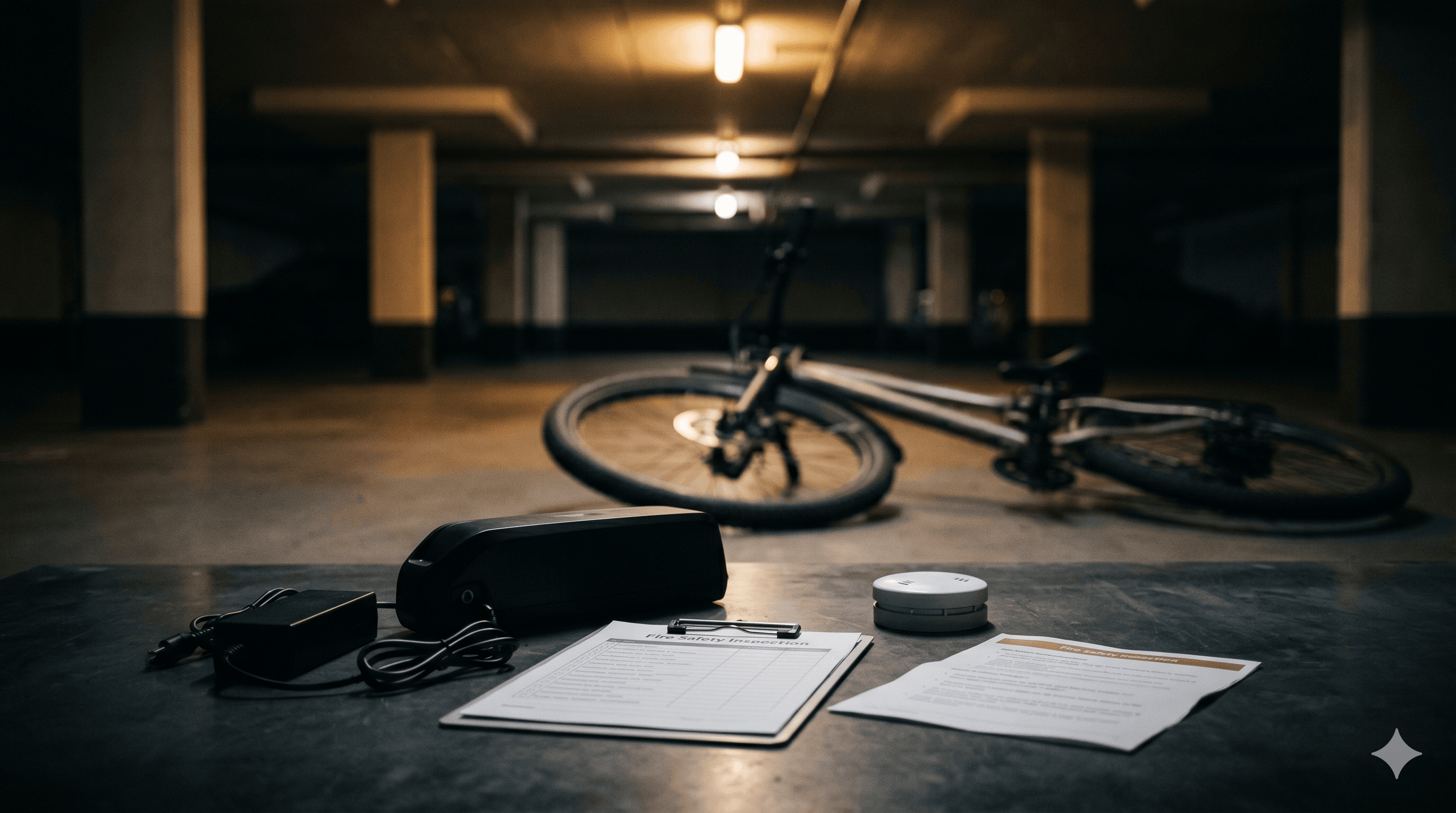
E-Bikes, E-Scooters and Lithium-Ion Batteries: The New Strata Fire Safety Rules for 2026
Fire and Rescue NSW recorded lithium-ion battery fires at a rate of 5.7 per week in 2024. By the end of 2025, that figure had grown again. The fires are no longer rare incidents reported in industry newsletters — they are a routine, weekly feature of urban firefighting, and the strata sector has become the front line.
In response, the NSW Government has implemented one of the most significant product safety regimes in recent memory. From 1 February 2026, every e-bike, e-scooter, e-skateboard, hoverboard and standalone lithium-ion battery sold in NSW must be tested, certified and marked under the Gas and Electricity (Consumer Safety) Act 2017. Penalties for breach reach $825,000 for corporations.
For owners corporations, the change is more than a consumer safety story. It restructures the fire risk profile of every apartment building in the state, raises new questions about by-laws, insurance and liability, and creates obligations that committees can no longer afford to ignore.
What Changed on 1 February 2026
The new regime requires every e-micromobility device and standalone lithium-ion battery sold in NSW — including second-hand devices and former hire fleet vehicles — to comply with prescribed Australian and international standards (AS 15194:2016 or EN 15194:2017+A1:2023 for e-bikes, with corresponding standards for other categories), to be tested by an accredited laboratory, and to carry a permanent certification label on the frame or battery housing.
NSW Fair Trading maintains a public register of certified products. Devices that are not on the register cannot lawfully be sold. Retailers, hire businesses and even private sellers offering second-hand devices are within the scope of the regulation.
Chargers were brought into scope earlier — they have been required to be tested, certified and marked since 2025. The 1 February 2026 date adds the devices and their batteries to the regime.
The Information Standard, which has been in force since 19 February 2025, requires suppliers to provide clear and accurate safety information at the point of supply. This includes details on safe use, charging, storage, fire prevention and disposal — and any retailer who fails to meet the standard is exposed to enforcement.
Why Strata Buildings Are Especially Exposed
Lithium-ion battery fires are not like conventional fires. When a battery enters thermal runaway — the self-sustaining chemical reaction that occurs when a cell is damaged, defective, or overcharged — it releases extreme heat (up to 1,600°C), toxic gases including hydrogen fluoride and carbon monoxide, and is extremely difficult to extinguish. Water does not stop thermal runaway. Battery fires can reignite hours, sometimes days, after they appear to be extinguished.
In a detached house, a battery fire is dangerous. In a strata building, it is potentially catastrophic. The fire is contained within shared walls, ceilings and ventilation systems. Smoke and toxic gases travel through stairwells, corridors, lift shafts and shared HVAC. Evacuation routes can be compromised within minutes. And once a fire is established, the heat output from a battery pack can ignite surrounding combustible materials before sprinkler systems are designed to respond.
This is why insurers and fire authorities have, since 2023, been pushing strata schemes to take the issue more seriously. The 2026 product safety regime is one piece of the response. By-law and policy changes at the building level are another.
What By-Law Powers Do Owners Corporations Actually Have?
The strict legal answer is that owners corporations cannot ban activities inside an individual lot unless the activity meets the threshold of an unreasonable nuisance, hazard, or breach of an existing by-law. A blanket "no charging e-bikes anywhere in your apartment" by-law is, on its face, a significant intrusion into private property rights.
But the practical legal answer is more nuanced. Section 153 of the Strata Schemes Management Act 2015 prohibits an owner or occupier from using their lot in a way that causes a nuisance or hazard to another occupier. A non-compliant, modified, or damaged battery pack stored or charged in a lot is plausibly a hazard within the meaning of section 153. The Model By-Laws also allow owners corporations to prohibit items that present a safety hazard or obstruct common property.
What this means in practice is that committees can legitimately introduce by-laws that:
Restrict the storage and charging of e-mobility devices on common property entirely. Common property is unambiguously within the OC's control, and devices stored in basement car parks, hallways, lift lobbies and bike rooms have been the source of multiple fatal fires in Australia and overseas.
Require that any device or battery used in the building must comply with the NSW certification regime — that is, must appear on the Fair Trading register or carry the prescribed certification mark. From February 2026, this is no longer a high bar; it is the legal baseline for any device sold in the state.
Prohibit the charging of e-mobility devices in lots overnight or while occupants are absent. Fire authorities universally recommend against unattended charging, and a by-law that codifies this for fire safety reasons is unlikely to be successfully challenged at NCAT.
Require notification when an owner or tenant brings an e-mobility device into the building, allowing the OC to verify certification status and provide safety information.
Prohibit the modification of batteries or chargers. Many of the most dangerous fires involve aftermarket battery upgrades, third-party chargers, or batteries built from individually sourced cells.
A blanket ban on e-bikes inside lots is harder to justify legally and is likely to be challenged. The defensible position is to regulate the risk, not prohibit the activity.
The Insurance Question
The insurance position on lithium-ion fires has been evolving rapidly. Until 2024, most strata insurance policies did not contain specific exclusions for battery fires — a fire was a fire, and the cause was generally not material to coverage.
That has begun to change. Some underwriters have introduced exclusions for fires caused by non-compliant or modified lithium-ion batteries. Others have introduced excess loadings for buildings without battery management policies. Strata Community Insurance has issued public statements indicating that charging of e-scooters or e-bikes in rooms is not recommended by manufacturers, and that any loss occurring may be treated as the resident's negligence.
The practical implications for owners corporations are significant. If a fire occurs in a building, and the cause is traced to a non-certified battery or a charging practice that breaches the building's by-laws, the path to a contested insurance claim — and potentially to the OC seeking recovery from the responsible owner — is now meaningfully open.
Committees should review their current strata insurance policy specifically for lithium-ion exclusions, sub-limits or loadings, and should ask their broker to confirm in writing the position on battery fires. This is no longer a default coverage area; it is a question to be asked.
What About Tenants?
Tenants are subject to the building's by-laws in the same way as owner-occupiers. A tenant who breaches a fire safety by-law is exposed to the standard by-law breach penalties at NCAT — currently up to $1,100 for a first breach, escalating to $5,500 for non-compliance with a Tribunal order.
The greater risk for tenants is the personal liability that flows from causing a fire. If a fire is traced to a tenant's non-compliant device, the tenant may be liable for damage to their own apartment, damage to other lots, damage to common property, and loss of rent for displaced occupants. Standard contents insurance may not cover liability of this scale, particularly where the tenant has breached either a by-law or the requirements of the new product safety regime.
For landlords renting in buildings with e-mobility by-laws, communicating those by-laws to tenants in writing — at the start of the tenancy and again whenever the by-laws change — is now a basic risk management step.
Best-Practice By-Laws: What Should Yours Look Like?
A robust e-mobility by-law for an Australian strata building in 2026 should address the certification requirement (only devices and batteries that are certified under the Gas and Electricity (Consumer Safety) Act 2017 may be stored or charged in the building), the charging location restrictions (no charging on common property; charging within lots permitted but subject to safety conditions), the prohibition on unattended charging (no charging overnight or while occupants are absent from the building), the prohibition on modified batteries (no aftermarket modifications; no use of non-original chargers), the storage requirements (devices stored in well-ventilated areas; not in evacuation paths or adjacent to combustible materials), and the notification obligation (owners and tenants must notify the OC when introducing an e-mobility device, providing certification details).
The by-law should be drafted by a qualified strata lawyer to ensure enforceability under the NSW framework, and should be reviewed against the building's existing fire safety policy, evacuation plan and insurance requirements.
The State-by-State Picture
NSW has moved first and moved hardest, but the issue is national.
| Jurisdiction | Product Safety Regime | By-Law Powers |
|---|---|---|
| NSW | Mandatory certification from 1 Feb 2026; $825K corporate penalties | By-laws can regulate storage and charging on common property; lot-based restrictions enforceable as nuisance/hazard under s153 SSMA |
| VIC | No equivalent product safety regime yet; under consideration | OCs can make rules under Owners Corporations Act 2006; enforceability of lot-based restrictions less tested |
| QLD | No specific lithium-ion regime; ACCC product recalls apply | By-laws can regulate common property; lot-based restrictions remain legally uncertain (Hynes Legal commentary) |
| WA | 166 lithium battery fires in 2024 (worst year on record); regulatory response under development | Strata Titles Act 1985 by-law powers comparable to NSW |
| SA | MFS callouts up nearly tenfold in 5 years; no specific regime | Standard by-law powers under Strata Titles Act 1988 |
| ACT, NT, TAS | No specific regimes | Standard by-law powers |
The trajectory is clear. NSW will not be the last state to introduce a certification regime, and committees outside NSW would be wise to draft by-laws now that anticipate the same direction of travel.
Practical Steps for Committees in 2026
The committees that will manage this issue best are those that act before an incident, not after. The practical agenda is reasonably contained.
Conduct a building audit of e-mobility devices currently in residence. Many committees have no idea how many e-bikes, e-scooters and standalone batteries are stored or charged in their building. A simple owner survey is the starting point.
Update by-laws to reflect the 2026 framework. If your building does not have a current e-mobility by-law, it is exposed. If it does, review whether the by-law references the new certification regime and prohibits non-compliant devices.
Review the building's strata insurance policy specifically for lithium-ion provisions, exclusions, excess loadings, and any conditions that require by-law-level enforcement of safety standards.
Provide owners and tenants with clear, written safety information at the start of each tenancy and at the AGM. Reference the Fair Trading certified products register, the FRNSW gold rules for safe charging, and the building's by-laws.
Update the building's evacuation plan and fire safety procedures to address the specific risks of lithium-ion fires, including the recommendation that battery fires be allowed to burn out under controlled conditions rather than attempted to be extinguished by occupants.
How UnitBuddy Helps
UnitBuddy's compliance and safety tracking module allows committees to record device certifications by lot, monitor by-law enforcement actions, track insurance policy positions on lithium-ion exposure, and surface safety notifications to owners and tenants. The system maintains an audit trail that, in the event of an incident, provides clear evidence of the steps the OC took to manage the risk — a critical record both for insurance claims and for any subsequent regulatory enquiry.
Lithium-ion fires are no longer a hypothetical risk. They are a weekly event in Australian cities, and the strata sector is unavoidably on the front line. The buildings that emerge from the next twelve months without an incident will be those that took the issue seriously before they had to.